
Fact or Fiction: Does Protein Need to Be Consumed Immediately After Training?
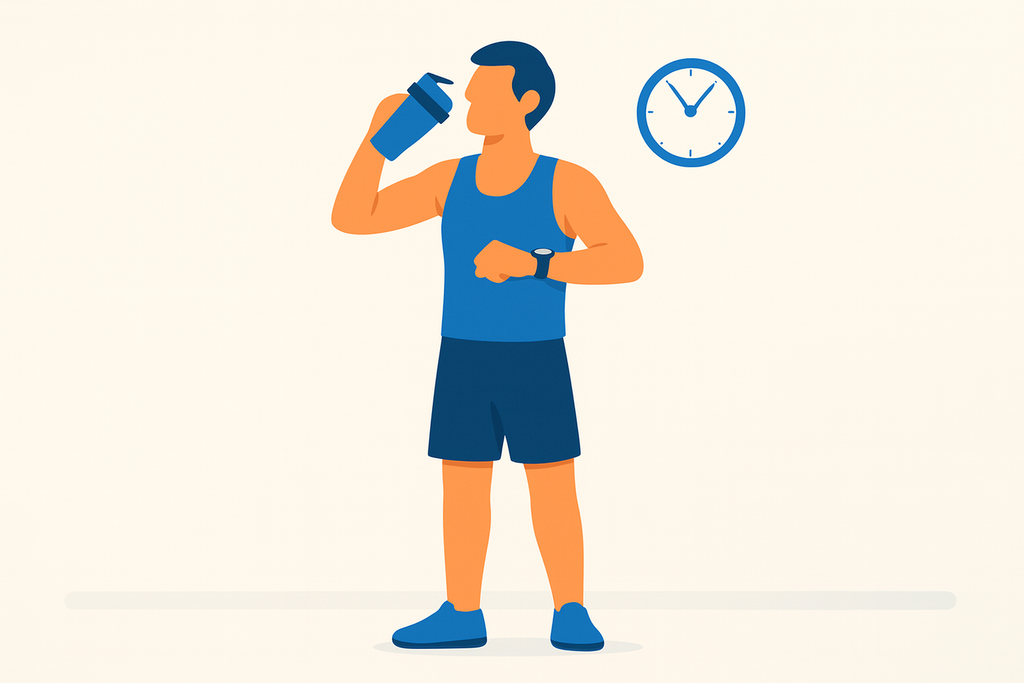
Among weightlifters in the fitness community, there is a popular idea called the anabolic window.
The anabolic window refers to the period after strength training during which one should consume protein.
Many believe the window lasts about 60 minutes and that consuming protein during that window will lead to greater gains in muscle mass than waiting 1-2 hours to eat. But does this strategy really make a difference?
Challenging the Status Quo
In 2013, a small group of researchers published a meta-analysis examining the existing literature on the so-called anabolic window. After analyzing 43 studies, they noticed a strong trend in the data.
They found that as long as total daily protein intake was 0.7g/lb of body weight, timing relative to the training bout didn’t affect muscle mass. In simpler words? They concluded that unless you’re training fasted, there is no anabolic window.

This makes sense, considering that muscle protein synthesis (MPS) peaks 24 hours after a resistance training bout. It takes 48-72 hours for MPS to return to baseline levels. If there were an anabolic window, it would be days, not hours. So then, how did it become such a popular idea in the first place?
The Rise and Fall of The Anabolic Window
The idea of the anabolic window is popular for a reason. Several studies were done in the 90s and early 2000s observing the effects of consuming protein and fast-digesting carbs together within 30-60 minutes post-exercise to maximize the anabolic response, recovery, and muscle gain.
In 2004, a book called Nutrient Timing by Ivy and Portman was published, compiling this research and popularizing the idea and term “anabolic window.”
The problem with the vast majority of these studies was this: they primarily used test subjects who trained in a fasted state or had methodological limitations (such as small sample sizes or uncontrolled variables).
If your goal is to build muscle, you probably aren’t training fasted, because let’s face it, it’s exhausting. After a meal, your body circulates the nutrients from that meal for 3 to 6 hours. This means that on an average training day, you may still be absorbing nutrients from your meal during and after your workout, making the lab conditions of fasting less of a concern in real life.
Given these real-world conditions, the majority of these early anabolic window studies generally don’t apply.

It’s Not About Timing, It’s About Quantity
Since the 2013 breakthrough meta-analysis, more researchers have conducted studies confirming that the anabolic window is a myth. Whether you have protein before or after your workout, whether you have even eaten protein recently or not, as long as you get enough protein in a day, your muscle size and strength gains will be the same.
So next time you finish weight training, don’t sweat it if you forgot your protein shake or just aren’t interested in eating until dinner. In reality, you have tremendous flexibility. Just be sure to hit your protein goal and stay consistent.
Sources:
https://pmc.ncbi.nlm.nih.gov/articles/PMC3577439/#sec6